Leadership & Workforce Management
Psychological Safety: How to Create Fearless Teams
August 26, 2026 - Elyce Wolfgang, CRA, FAHRA
Abstract
“Psychological safety” is defined in Amy Edmondson’s 2019 book, “The Fearless Organization,” as “a climate in which people feel comfortable sharing concerns and mistakes without fear of embarrassment or retribution.” Creating a work environment that supports learning is essential in today’s ever-challenging healthcare environment. Team-based learning includes sharing knowledge, offering suggestions, and brainstorming better approaches, all while destigmatizing failure. Psychological safety is an essential aspect of creating a high-reliability organization.
Psychological safety promotes diverse views and perspectives, but it’s difficult to change the perception that critical discussions are synonymous with conflict. It’s also difficult to change the perception that mistakes are synonymous with failure. As leaders, we can help our team members embrace mistakes, problems, and critical discussions. Taking it a step further, we can learn from the discussions and mistakes and create solutions that solve the root cause of the problem.
In this article, we will explore what psychological safety is and is not. We will also explore the history of psychological safety and high-reliability organizations, the four stages of psychological safety, and how imaging leaders can support their teams to become fearless.
My organization, WellSpan Health, started its psychological safety journey four years ago. We had already implemented Lean Daily Management System, but we kept seeing the same problems pop up again and again. We realized this was happening because we didn’t create a psychologically safe environment for our teams to work in. They didn’t feel empowered to speak up. As a result, we were often putting band-aids on our problems instead of preventing them from occurring in the first place.
Psychological Safety: What It Is (And Isn’t)
Psychological safety and team-based learning is directly related to increasing employee engagement, patient experience, and financial gains. It is a concept often intertwined with high-reliability organizations and offers a number of tools and methods to help leaders create a fearless team.
Psychological safety supports learning from mistakes. As leaders, we support learning by valuing honesty over correct answers. It’s asking, “Tell me what actually happened, not what you think I want to hear.” It’s a focus on quality improvement and sharing that knowledge for the betterment of the care we provide.
Psychological safety is not about being nice. We can’t continue to tiptoe around safety issues and concerns. It may make people feel better in the moment, but it prolongs the inevitable.
Psychological safety is not a personality factor; it can be taught. It is not another word for trust. Although trust is foundational to psychological safety, it is not the end-all-be-all. And psychological safety is definitely not about lowering standards.1
A Brief History
Psychological Safety
In the 1960s, MIT professors Edgar Schein and Warren Bennis asserted psychological safety was “essential for making people feel secure and capable of changing their behavior in response to shifting organizational challenges.” We encounter shifting organizational challenges daily. Schein further stated, “individuals are free to focus on collective goals and problem prevention rather than on self-protection.”2 Our teams can be more fearless if every team member is engaged in problem prevention, rather than problem resolution.
From the 1960s to the 1990s, we didn’t hear much on the topic of high-reliability organizations, nor was there much research done on the topic. Fast forward to the 1990s where a rebirth occurred and William Kahn conducted a qualitative study of different organizations to demonstrate the connection between psychological safety and employee engagement.
This research uncovered a quantitative relationship. Kahn detailed his assertion of “benefit of the doubt,” where trust and respect are defining characteristics of psychological safety in the workplace.
At WellSpan Health, we call it “assuming positive intent,” which is one of our core values. It means we afford our coworkers the benefit of the doubt by saying to ourselves, “I know Vonn wouldn’t purposely forget to do that step in the workflow,” or, “I’m sure Marie didn’t mean to speak with that tone, maybe she’s having a bad day. I should ask her how I can support.”
High-Reliability Organizations
High-reliability organizations are organizations that operate in a complex, high-hazard domain for extended periods without serious accidents or catastrophic failures. There are five main concepts that high-reliability organizations excel in3:
- Preoccupation with failure
- Reluctance to simplify
- Sensitivity to operations
- Deference to expertise
- Commitment to resilience
The concept of high-reliability organizations started later than psychological safety. It wasn’t until the 1970s that the airline industry catapulted it into the mainstream. A deadly United Airlines accident resulted in crew resource management, focusing on communication, decision-making, and reducing variation. The concept of “failure is not an option” was solidified.
It wasn’t until the 1980s that high-reliability organizations launched into the healthcare sector, starting with Loma Linda University Children’s Hospital PICU. Then in the 1990s, the American Medical Association (AMA) formed the National Patient Safety Foundation and engaged in a formal research project on healthcare and high-reliability organization concepts.4
Combining Psychological Safety and High-Reliability Organizations
When we combine psychological safety and high-reliability organizations, there are many positive gains. Leaders create a culture of safety: trust in each other, trust in leadership, accountability, identifying unsafe conditions before they cause harm, strengthening systems and processes, and constantly assessing how things operate. Leadership gains inclusiveness and develops safety behaviors in staff, which addresses errors and process weaknesses proactively.
When psychological safety and high-reliability organizations join forces, they create the dream team of robust process improvement. But you cannot become a fearless team that’s highly reliable if you do not have psychological safety. Now more than ever, we need psychological safety to excel in this competitive market.
The 4 Stages of Psychological Safety
To understand how to create a fearless team, it’s worth exploring the four stages of psychological safety. These stages are detailed by Timothy Clark in his book, “The 4 Stages of Psychological Safety.” Each stage’s needs must be met before rising to the next. The four stages are5:
- Inclusion
- Learner Safety
- Contributor Safety
- Challenger Safety
Stage 1: Inclusion
This stage encompasses informal acceptance to the team. The respect is individual humanity and permission for an individual to enter your personal society. Inclusion is a sensitivity to and appreciation of cultural differences.
Did you have someone take you under their wing this week? Show you the ropes at a new task? Invite you to coffee just to catch up? This is inclusion safety.
Now think of your teams at work. Is everyone from the same background? Do they all think the same way? As a leader, we shouldn’t hire cookie cutter people. We need to foster an inclusive team dynamic that is free of biases and fosters positive self-regard.
As a leader, how do you foster positive self-regard? How do you show support and acceptance, regardless of what someone says or does?
Stage 2: Learner Safety
This is the “free zone” — free to learn and engage, ask questions, and experiment free of judgment. Free of neglect, manipulation, and coercion. There is respect for the person’s need to learn and grow (think Maslow’s hierarchy of needs) and permission to engage in the learning process.
As leaders, we must commit to creating a supportive and encouraging environment; have patience with learners, and share power, credit, and resources.
Stage 3: Contributor Safety
We must have active participation from every team member for them to feel like they are truly autonomous. This involves respect for the person’s ability to create value and permission to work independently and exercise their own judgment. I’ve had team members call me after hours because they have a problem that needs to be solved. I always ask them what they think they should do. This shows that I trust their judgment, and it empowers them to do what they feel is right. Afterwards, we debrief to reflect on it and decide if there were any additional solutions that would have had a different outcome.
Trust your employees to execute so they can be creative and innovate new ideas you probably didn’t consider. Focus on the outcome. They may not take the same route you would, but does that matter if the problem is resolved?
Stage 4: Challenger Safety
This is the key to creativity. Kim Scott authored “Radical Candor,” which showcases the need for successful teams to be able to challenge the status quo without fear of retribution6. Learning is more important than the result.
At PIXAR, “try a lot, triumph a little” is on full display, where Ed Catmull encouraged his teams to fail often and early in the process. Through this approach, Mr. Catmull fostered the challenger environment by having open, candid critique sessions with his animation teams.1
We have a core value at my organization called “Find a better way.” We can only find a better way when we can speak up with new, innovative ideas. Sometimes that comes with some failures or opportunities for improvement.
Tools That Promote Psychological Safety
If you have ever been part of Lean Six Sigma work, you’ve likely leveraged tools such as A3s, a one-page report used for problem-solving or continuous improvement processes.
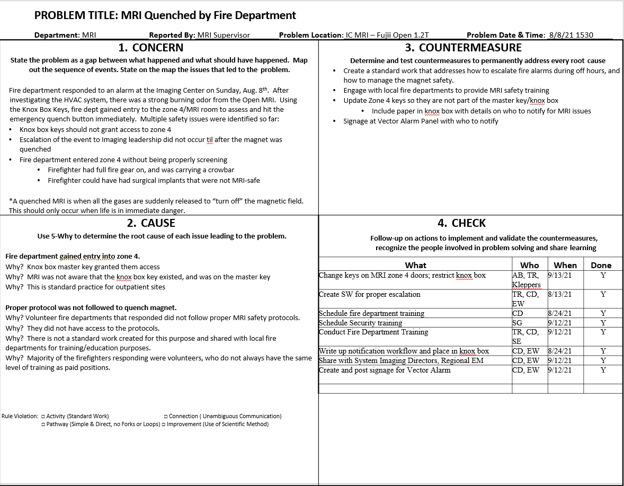
As part of our Lean daily management processes at WellSpan Health, we implemented a simplified variant of an A3 called a 4C. It contains the following components:
- Concern: What should have occurred versus what did or did not occur.
- Cause: By asking five “whys,” we are solving to the root of what caused the concern to occur.
- Countermeasures: What can we put into place to prevent the concern from happening again.
- Check: Who is responsible for ensuring the countermeasures are implemented and by when.
By utilizing the overarching concepts of process improvement, you create a pathway to all the states of psychological safety when working through a 4C as a team. Gathering your team members who perform the work will facilitate the inclusion and learner stages by talking through the concern with zero judgment. This is where you discuss what went wrong without fear of retribution and show your support.
Transitioning into countermeasures helps solidify the contributor phase by allowing team members to brainstorm how to fix the concern. As a leader, you are instilling your trust in their judgment.
The countermeasures also segue to the challenger stage, because this is when they are free to critically think and come up with solutions that will prevent the issue from occurring again. Finally, the check brings the concern to a close and action plans are officially implemented.
Psychological Safety in Action: A Real-World Example of 4C
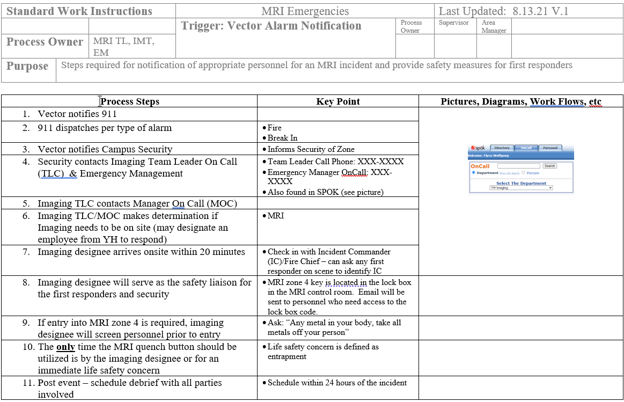
Below is an example of a 4C that resulted in an updated standard of work and education.
We had an event where smoke and a burning smell were emitting from the MRI space at an imaging center that was closed. The fire department responded first, and one of their volunteers hit the quench button in the hopes of exploring the source of the burning in zone 4.
Follow along in the 4C below to see how we assessed the concern, determined root causes, and implemented countermeasures and checks.
4C Example
Resulting Standard of Work
Conclusion
As leaders, we must create psychological safety among our teams to be the best we can be for our patients and each other. We can address team members’ fears and reduce social friction, which will strengthen our innovative spirit and eliminate risks while reducing harm to patients.
In the sea of interactions with our teams, we have the ability to make the waves bigger, setting the boat off course or struggling through the storm. Or we can put wind in the sails of the boat and guide our teams fearlessly into the future.
References
- Edmondson, Amy C. The Fearless Organization. John Wiley & Sons, 2018.
- Schein, Edgar H., and Bennis, Warren G. Personal and Organizational Change Through Group Methods: The Laboratory Approach. John Wiley & Sons, 1965.
- “High Reliability|PSNet” Home|PSNet, https://psnet.ahrq.gov/primer/high-reliability. Accessed 28 May 2023.
- “HRO Has Prominent History – Anesthesia Patient Safety Foundation.” Anesthesia Patient Safety Foundation, https://www.apsf.org/article/hro-has-prominent-history/#:~:text=Commercial%20aviation%20was%20the%20first,group%20research%20on%20team%20building. Accessed 28 May 2023.
- Clark, Timothy R. The 4 Stages of Psychological Safety. Berrett-Koehler Publishers, 2020.
- Scott, Kim. Radical Candor: Be a Kick-Ass Boss Without Losing Your Humanity. St. Martin’s Press, 2017.